A postdoc, short for postdoctoral position, is a temporary research role held by someone who has recently earned a doctorate. In the United States, postdocs are a common step between a PhD and a faculty position, particularly in the life and physical sciences, where several years of postdoctoral work are often expected before applying for tenure-track jobs.
Purpose and function
Postdoctoral positions allow researchers to deepen their expertise, learn new methods, build a record of publications, and develop professional networks. Many postdocs also gain experience mentoring graduate students, writing grant proposals, and managing projects, all of which are valued in faculty hiring.
Types of postdoctoral positions
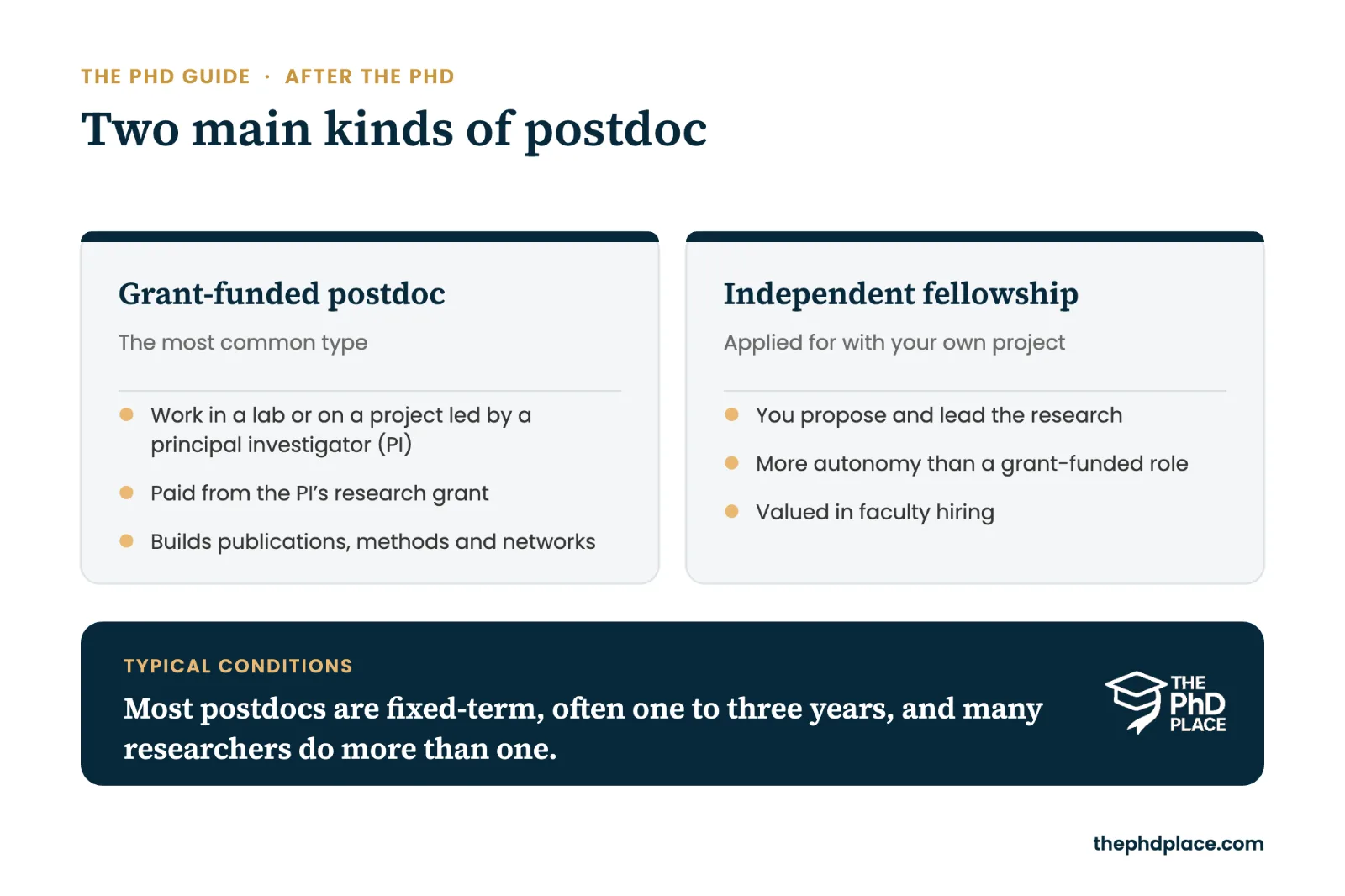
The most common type is a grant-funded position in which the postdoc works in a lab or on a project led by a principal investigator (PI). Another is the independent fellowship, which researchers apply for with their own project and which offers more autonomy. In the humanities and social sciences, postdocs may combine research with teaching. Job titles include postdoctoral researcher, postdoctoral fellow, and postdoctoral scholar.
Free weekly newsletter
Reading about PhDs is not doing one.
The Prof’s notes: one email a week with one job to do and how to do it, plus your key to the 24/7 Writing Club.
One email a week. Unsubscribe anytime.
Typical conditions
Postdocs are usually fixed-term, often lasting one to three years, and many researchers complete more than one. Positions frequently require relocation. Salaries and benefits vary by institution, field, and funding source; in the biomedical sciences, many institutions use federal guidelines as a reference point for minimum pay. The financial implications are discussed in The financial realities of a PhD and academic careers.
Diversity and variation
In the life sciences, multiple postdocs before a faculty position are common. In engineering and computer science, many graduates move directly into industry or faculty roles. In the humanities, postdoctoral positions are fewer and highly competitive.
Common misunderstandings
A postdoc is sometimes assumed to guarantee a faculty position. In practice, many postdocs go on to careers outside universities, as described in Leaving academia after a PhD.
It is also commonly assumed that a postdoc is simply an extension of graduate school. Postdocs are employees with greater responsibility and increasing expectations of independence.
 Kate Aguilar