
PhD funding refers to the financial arrangements that cover the costs of doctoral study: tuition, living expenses, and research costs such as equipment, fieldwork, or travel.
In the United States, most full-time PhD students in research-focused programs receive funding from their university, often as a package that combines tuition remission with a stipend. How a PhD is funded affects not only a student’s finances but also their workload, independence, and obligations such as teaching.
Main sources of funding
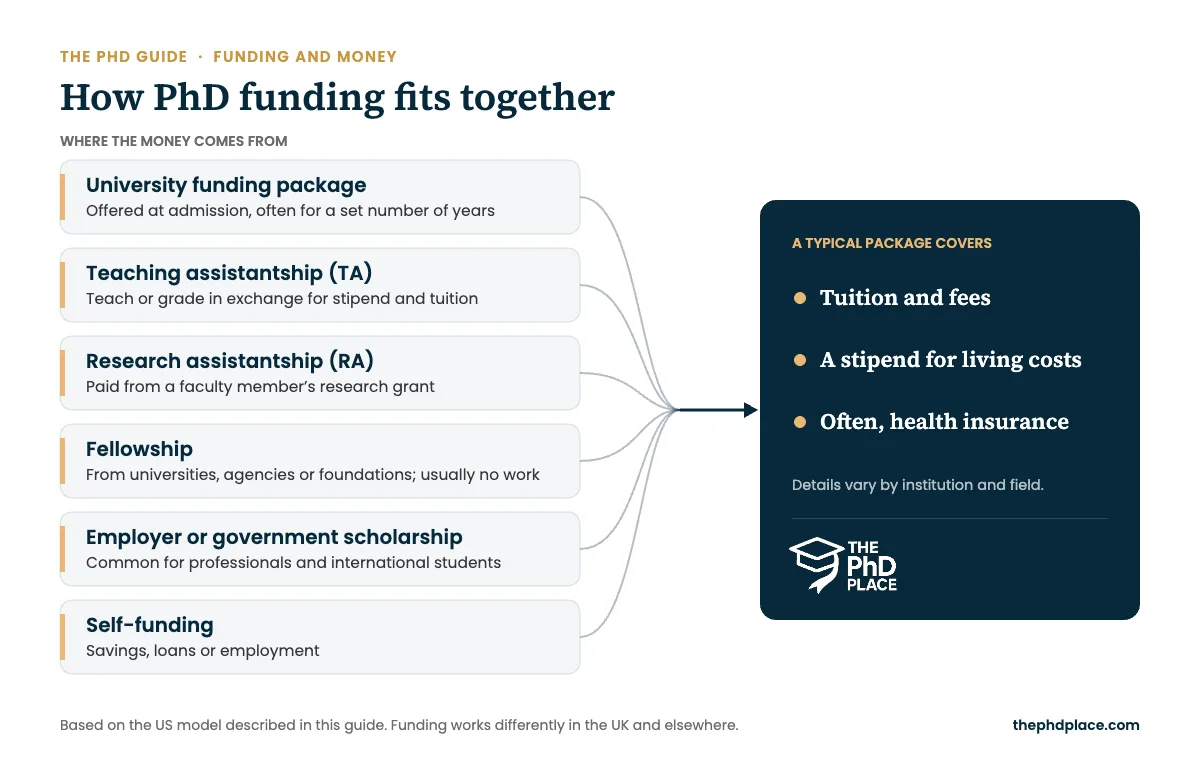
Doctoral funding in the US commonly comes from:
- University funding packages, offered at admission and often guaranteed for a set number of years.
- Teaching assistantships (TAs), where students teach or grade in exchange for a stipend and tuition remission.
- Research assistantships (RAs), paid from faculty research grants.
- Fellowships, awarded by universities, federal agencies, or foundations, which usually carry no work obligation.
- Employer sponsorship or foreign government scholarships, particularly for professionals and international students.
- Self-funding through savings, loans, or employment, which is more common in some professional and part-time programs.
What a funding package covers
A typical package covers tuition and fees, provides a stipend for living costs, and often includes health insurance. Details vary widely by institution and field, and are compared in PhD funding packages: fellowships, assistantships and stipends.
Variation by field
Funding is generally most consistent in the sciences and engineering, where research grants support many students. In the humanities and some social sciences, students more often rely on teaching assistantships, and guaranteed funding may end before the dissertation is complete. Professional doctorates, such as some EdD programs, are less often fully funded.
International comparison
In the UK, PhDs are often funded through studentships covering three to four years. In several European countries, including the Netherlands and the Nordic countries, doctoral candidates are commonly employed as university staff with a salary.
Common misunderstandings
It is often assumed that a PhD must be paid for like other graduate degrees. In many US research programs, admitted students pay no tuition and receive a stipend, although this is not universal.
Another misunderstanding is that funding lasts as long as the PhD takes. Packages usually cover a fixed number of years, and students who take longer may need to find additional support. The wider picture is discussed in The financial realities of a PhD and academic careers.