A PhD application is the process through which prospective doctoral researchers apply to undertake a research degree at a university or research institution. Unlike many undergraduate and Master’s applications, PhD applications often involve both admission to a program and assessment of a proposed research project, advisor fit, and funding arrangements.
The exact process varies by country, institution, discipline, and type of PhD. Some applicants apply to an advertised funded project, while others develop their own research proposal and approach a potential advisor before submitting a formal application.
What a PhD application is assessing
PhD admissions are not based only on academic grades. Universities are usually trying to assess whether an applicant is prepared for doctoral-level research and whether the proposed project can realistically be supported.
This may include assessing:
- Academic background and previous research experience
- The quality and feasibility of the proposed research
- Fit with available advisors and institutional expertise
- Evidence of independent thinking and research potential
- Relevant methodological or subject knowledge
- Availability of funding and resources
These expectations reflect the wider purpose of doctoral study and the level of independence involved in what PhD study actually involves.
Application routes
There is no single application route. The process depends partly on how the doctoral project itself is organized.
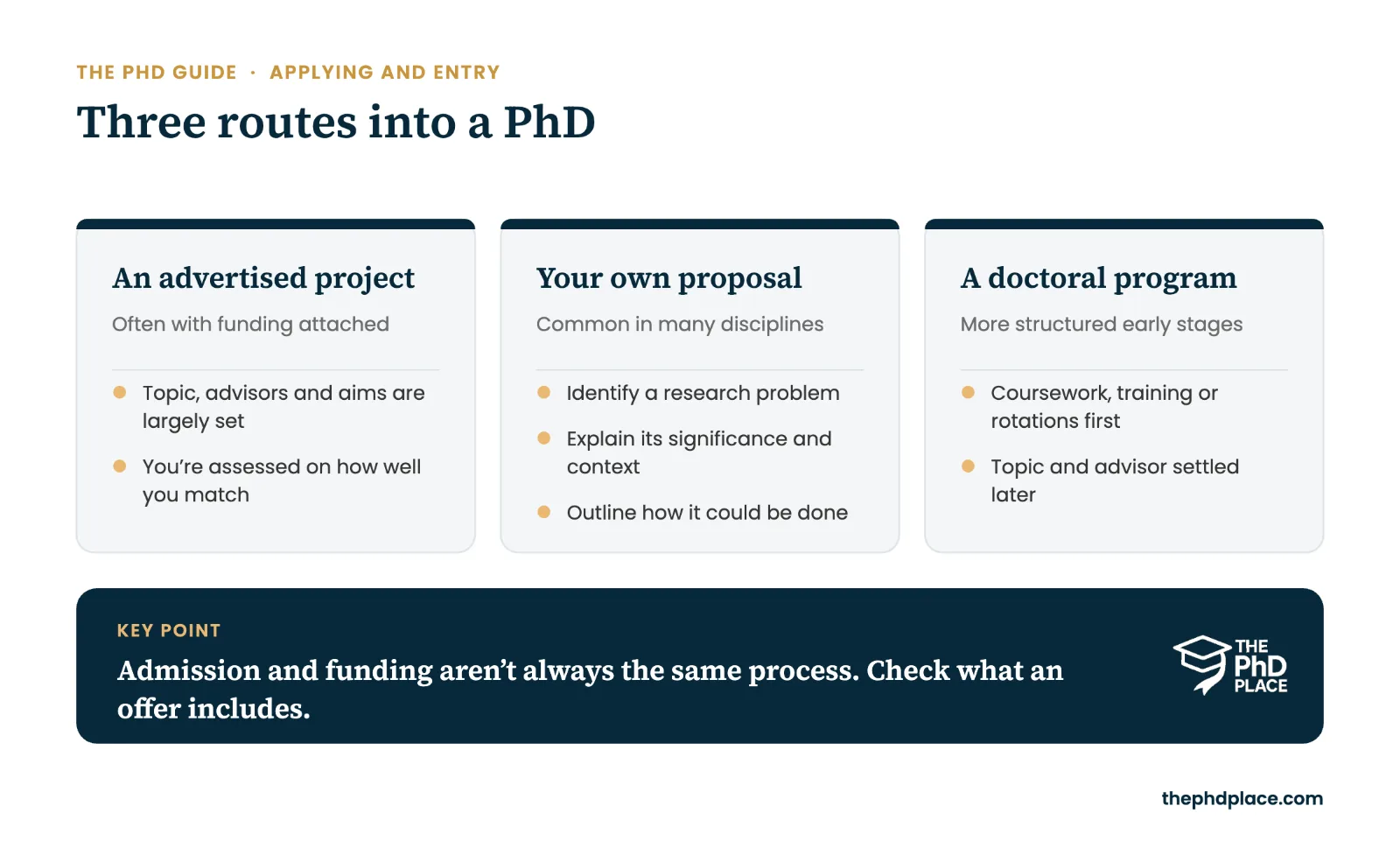
Applying for an advertised PhD project
Some PhDs are advertised around a predefined research project, often with funding already attached.
In this model, applicants usually apply for a specific position. The broad research topic, advising team, funding arrangement, and project aims may already have been established.
Applicants are then assessed on how well their experience and skills match the project.
Proposing your own research project
In many disciplines, applicants develop their own research topic and submit a research proposal as part of the application.
This usually requires identifying a research problem, explaining its significance, situating it within existing scholarship, and outlining how the research could be conducted.
Developing a viable project often begins with choosing a research topic and identifying researchers whose expertise aligns with the proposed work.
Free weekly newsletter
Reading about PhDs is not doing one.
The Prof’s notes: one email a week with one job to do and how to do it, plus your key to the 24/7 Writing Club.
One email a week. Unsubscribe anytime.
Applying to a doctoral program
Some systems recruit students into broader doctoral programs rather than directly into one predefined project.
Applicants may complete coursework, research training, or rotations before finalising their dissertation topic or advising arrangements.
This is particularly common in systems where doctoral education is more structured during the early stages.
Finding a potential advisor
In many PhD application systems, identifying a suitable advisor is an important part of the process.
A advisor should normally have expertise relevant to the proposed research and sufficient capacity to support the project. Applicants may contact potential advisors before applying to discuss research fit and whether they are currently accepting new doctoral researchers.
The role and importance of this stage varies between institutions. Some require applicants to secure informal advising support before submitting an application, while others assign advisors after admission.
The process is explored in more detail in Finding a advisor.
The research proposal
A research proposal explains what the applicant intends to investigate and how the project could contribute to existing knowledge.
Requirements vary widely, but proposals commonly include:
- A research question or problem
- Background and academic context
- Existing literature relevant to the project
- Proposed methods or approach
- The potential contribution of the research
- A provisional timetable or project plan
A proposal is not usually treated as a fixed contract for the entire PhD. Research questions and methods often change as the project develops.
Its purpose during admission is primarily to demonstrate that the applicant can formulate a coherent research problem and think seriously about how it might be investigated.
Academic qualifications and entry requirements
Universities set their own academic entry requirements.
Some PhD programs require a relevant Master’s degree. Others allow applicants to enter directly from undergraduate study, particularly in systems where substantial research training is incorporated into the doctoral program itself.
Requirements may also include minimum grades, previous research experience, language proficiency, or subject-specific qualifications.
The distinction between graduate and doctoral study is discussed further in PhD vs Master’s: what’s the difference?.
Meeting the minimum entry requirements does not automatically guarantee admission. PhD places may be limited by advising capacity, funding, research fit, and competition from other applicants.
Documents commonly required
Application requirements differ, but applicants may be asked to submit:
- Academic transcripts
- Degree certificates
- A CV or academic résumé
- A personal or supporting statement
- A research proposal
- References or recommendation letters
- A writing sample
- Evidence of English-language proficiency where applicable
Academic CVs and supporting statements are considered in more detail in Academic resumes and statements.
References
PhD applications commonly require academic references from people who can comment on the applicant’s academic ability, research potential, or suitability for doctoral study.
References may come from previous advisors, lecturers, research collaborators, or other academics familiar with the applicant’s work.
Institutions may contact referees directly or ask applicants to provide reference letters as part of the application.
Interviews and selection
Many PhD applications include an interview.
The interview may assess the applicant’s understanding of the proposed research, ability to discuss academic ideas, methodological awareness, and fit with the advising team or research environment.
Applicants may also be asked to explain why they want to undertake the PhD and how their previous experience has prepared them for doctoral research.
Some selection processes include additional stages such as written tasks, presentations, or discussions of the research proposal. These are covered in more detail in Interviews, proposals, and selection processes.
Funding and admission
Admission and funding are not always the same process.
An applicant may be academically accepted onto a PhD program without automatically receiving financial support. In other cases, funding is attached directly to the doctoral position and is awarded as part of the same selection process.
Funding may take the form of scholarships, stipends, research grants, employment contracts, or self-funding arrangements.
The main models are explained in How PhDs are funded and Scholarships vs stipends vs self-funding.
Applicants therefore need to establish separately whether an offer of admission includes funding and what costs that funding covers.
What happens after an application is submitted
After submission, an application may be reviewed by potential advisors, departmental admissions staff, funding panels, or a combination of these.
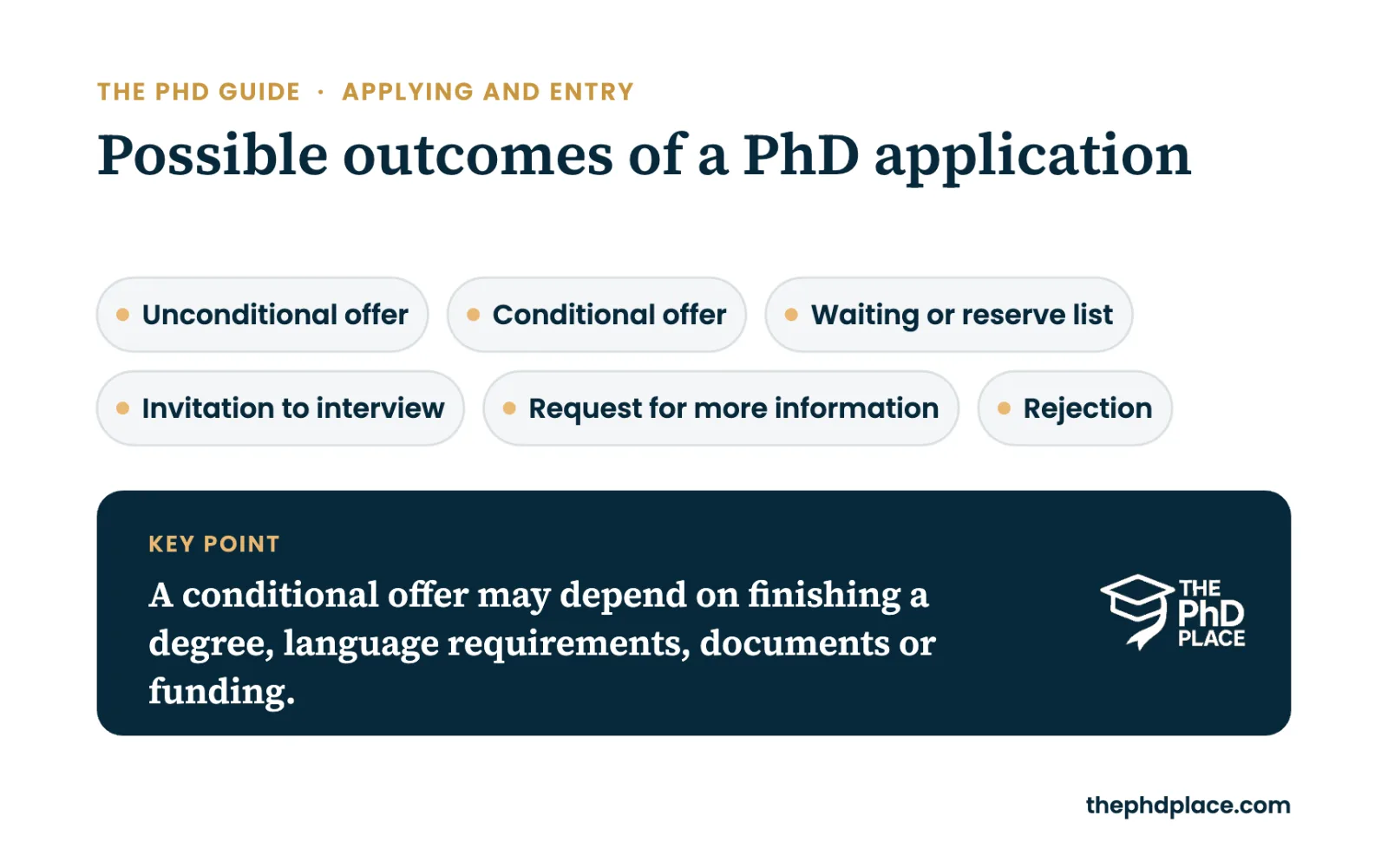
Possible outcomes include:
- An unconditional offer
- A conditional offer
- Placement on a waiting or reserve list
- An invitation to interview
- A request for revisions or additional information
- Rejection
A conditional offer may depend on completing an existing qualification, meeting language requirements, providing documentation, or securing funding.
Processing times vary considerably between institutions and application routes.
Common misunderstandings
"You need a fully developed PhD project before applying"
Not always. Some programs expect a detailed proposal, while others recruit applicants to predefined projects or broader doctoral programs.
Even where a proposal is required, the project will usually continue to develop after admission.
"You must already have a advisor before applying"
This depends on the institution. Some universities expect applicants to contact a advisor in advance, while others allocate advisors during or after the admissions process.
"Getting accepted means the PhD is funded"
Not necessarily. Admission and funding may be assessed separately.
An applicant can receive an academic offer without receiving a scholarship or stipend.
"The highest grades always win"
Academic performance matters, but doctoral admissions also involve research fit, project quality, advising availability, methodological preparation, and evidence of research potential.
"The research proposal cannot change after admission"
Research projects commonly change during doctoral study as researchers engage more deeply with the literature, methods, data, and practical realities of the project.
Frequently asked questions
When should you apply for a PhD?
Application timelines vary considerably. Advertised funded positions may have fixed deadlines, while some universities accept applications throughout the year.
Applicants seeking competitive scholarships often need to begin significantly earlier because funding deadlines may fall before general admissions deadlines.
Do you need to contact a advisor before applying?
Sometimes.
In systems where applicants propose their own research, contacting a potential advisor before submitting the formal application can help establish whether there is an appropriate academic fit.
Other programs explicitly ask applicants not to contact individual advisors before applying.
Applicants should therefore follow the requirements of the institution and program concerned.
Can you apply for a PhD before finishing your Master’s?
Often, yes.
Applicants may receive a conditional offer requiring successful completion of their current degree before doctoral enrollment.
Specific requirements depend on the university and program.
How many PhD programs should you apply to?
There is no standard number.
Applicants often apply to more than one program because admission depends on several factors beyond academic ability, including funding, advisor availability, and institutional fit.
Applications should nevertheless be tailored to each institution rather than submitted as identical generic applications.
Can you apply for a PhD without a Master’s?
In some systems, yes.
Some doctoral programs admit students directly from undergraduate study, while others normally require a Master’s or equivalent graduate qualification.
The difference reflects broader international variation in how doctoral education is structured.
Can you apply for a PhD in a different subject?
Sometimes.
Interdisciplinary and cross-disciplinary applications are common, particularly where applicants can demonstrate relevant knowledge, research skills, or methodological preparation.
Admissions decisions depend on whether the proposed project is academically credible and can be supported within the department.
 Amelia Watkins-Smith