
PhD study is an extended period of advanced coursework and supervised, independent research leading to a doctoral degree. Its central product is a dissertation that makes an original contribution to knowledge, which is assessed at a dissertation defense.
Day-to-day doctoral work is less structured than undergraduate study, and much of it is self-directed, particularly after the first two years.
Typical stages of a US PhD
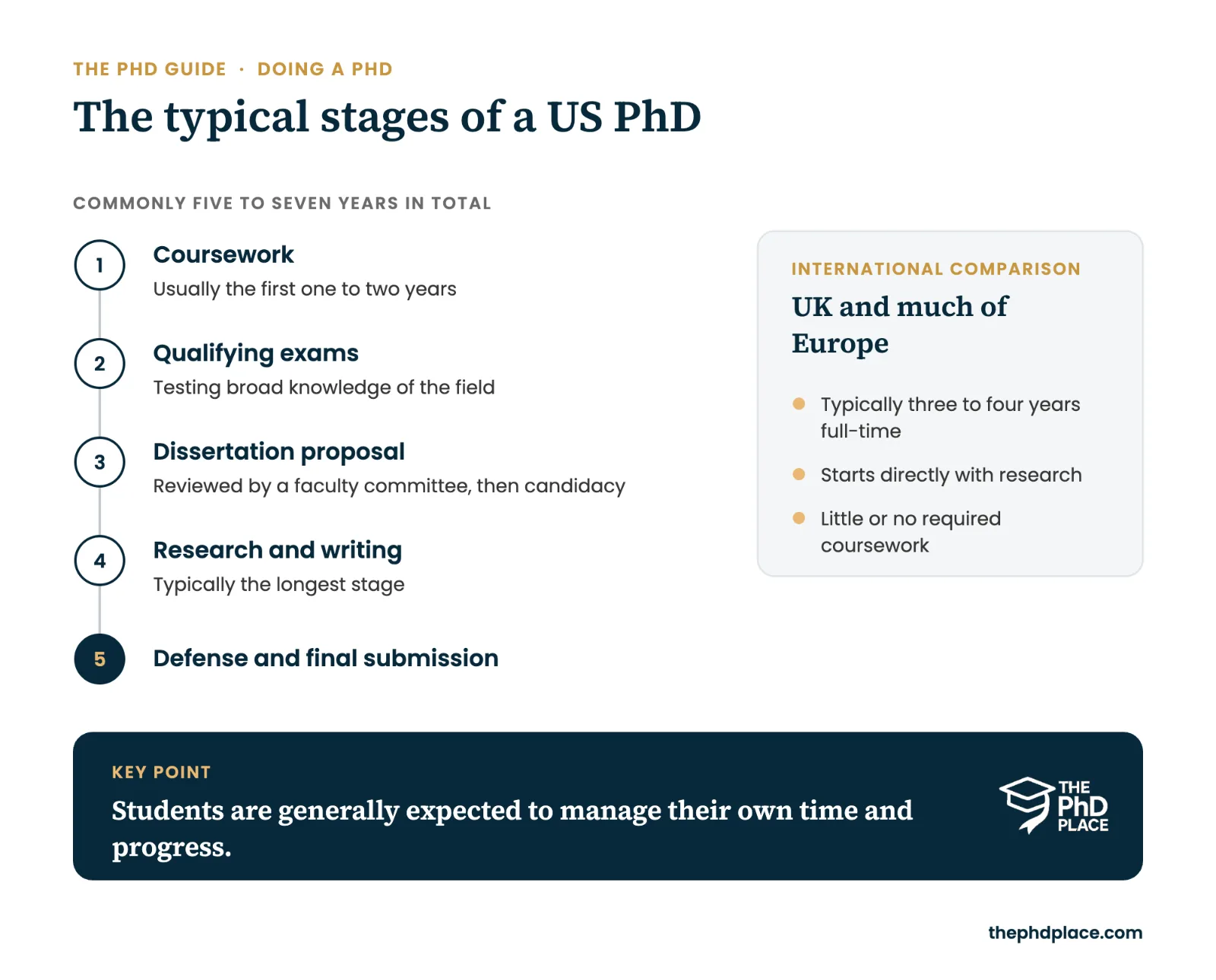
Most US PhD programs follow a broadly similar sequence:
- Coursework, usually in the first one to two years.
- Qualifying or comprehensive exams, which test broad knowledge of the field, described in Coursework, qualifying exams and research training.
- The dissertation proposal, reviewed by a faculty committee, after which students usually “advance to candidacy.”
- Dissertation research and writing, typically the longest stage.
- The defense and final submission.
Typical activities
Day-to-day work commonly includes reading, designing and refining research, collecting or generating data, analysis, and writing. Alongside this, students meet with their advisor, attend seminars, present at conferences, and often teach as teaching assistants.
Duration
US PhDs commonly take five to seven years, with considerable variation by field. Programs in the humanities often take longer than those in engineering and the physical sciences. Part-time and professional doctorates follow different timelines.
International comparison
In the UK and much of Europe, PhDs typically last three to four years full-time and begin directly with research, with little or no required coursework, since students usually enter with a master’s degree.
Common misunderstandings
A PhD is often imagined as continuous discovery. In practice, much of the work involves routine tasks, revision, and dealing with setbacks.
It is also commonly assumed that PhD students are told what to do day to day. Advisors provide guidance, but students are generally expected to manage their own time and progress, which is a key difference from earlier degrees. Related pressures are discussed in Work–life balance in research.