
Transferable skills are capabilities developed in one setting that can be applied in others. For PhD holders, the term usually refers to skills built during doctoral study that are valuable beyond a specific research topic, including in careers outside academia.
Skills commonly developed during a PhD
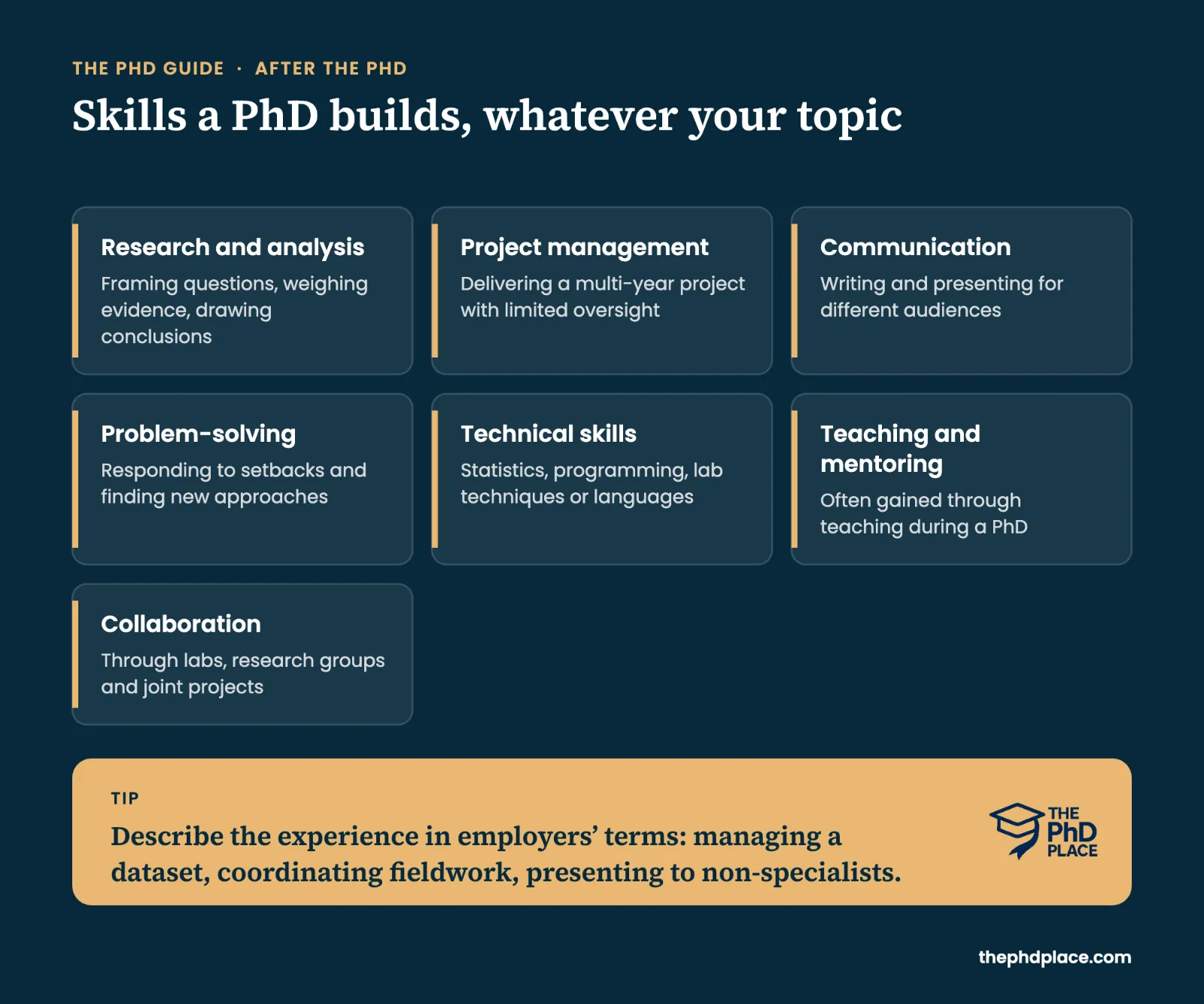
Skills frequently associated with doctoral training include:
- Research and analysis: framing questions, gathering and evaluating evidence, and drawing conclusions.
- Project management: planning and delivering a multi-year project with limited oversight.
- Communication: writing for different audiences, presenting, and explaining complex ideas clearly.
- Problem-solving: responding to setbacks and finding alternative approaches.
- Technical skills: such as statistics, programming, lab techniques, or languages.
- Teaching and mentoring, often gained through teaching during a PhD.
- Collaboration, through labs, research groups, and joint projects.
Recognizing and describing skills
PhD students often find it hard to recognize their skills because they develop them through academic tasks rather than naming them as such. Career centers and professional development offices at many US universities help graduate students translate experience into terms employers understand, for example by describing managing a dataset, coordinating fieldwork, or presenting to non-specialists, rather than listing publications.
Why they matter
Transferable skills underpin both academic careers and careers elsewhere. For those leaving academia, they are often the main way employers understand the value of a doctorate.
Diversity and variation
The skills developed vary by field and project. Lab scientists may build strong technical and teamwork skills, while humanities researchers often develop advanced writing, interpretation, and independent working. Opportunities to build skills through teaching, internships, and training also differ between programs.
Common misunderstandings
It is sometimes assumed that a PhD develops only narrow specialist knowledge. Most PhD holders develop a broad range of capabilities, even when these are not explicitly labeled.
It is also commonly believed that employers outside academia do not value doctorates. Many do, particularly when candidates describe their experience in terms relevant to the role. Wider perspectives are discussed in Redefining success after a PhD.