
Academic career paths are the routes through which people build careers at colleges, universities, and research institutions after completing a doctorate. In the United States, they are shaped by the tenure system, the growth of non-tenure-track teaching roles, and the wide range of institution types.
Only a minority of PhD graduates go on to tenure-track faculty positions, and many build careers in other sectors, as described in Leaving academia after a PhD.
The tenure track
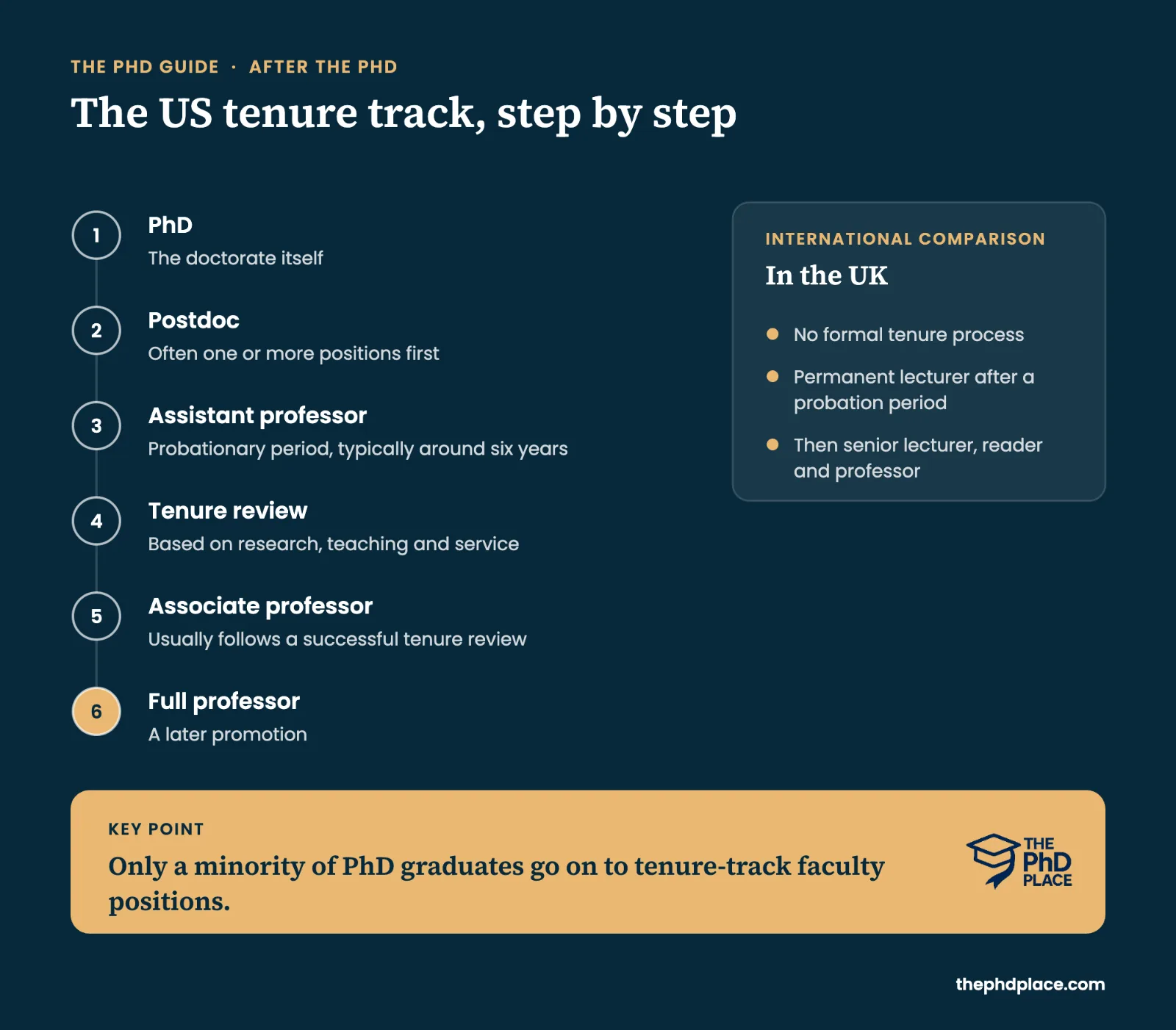
The traditional academic path in the US begins with an appointment as an assistant professor, often after one or more postdoc positions. After a probationary period, typically around six years, faculty go through a tenure review based on research, teaching, and service. Those who receive tenure are usually promoted to associate professor, and later may be promoted to full professor.
Non-tenure-track roles
A large share of US college teaching is done by non-tenure-track faculty, including lecturers, instructors, teaching professors, and adjunct faculty paid per course. Some of these roles are full-time and long-term; others are part-time and insecure. Research-only roles, such as research scientist or staff scientist positions, are often tied to grant funding.
Types of institutions
Expectations differ by institution. Research universities emphasize publications and grant funding; liberal arts colleges emphasize teaching alongside research; and community colleges focus mainly on teaching. Many PhD holders also work in academic administration, research management, or student support.
What shapes progression
Factors commonly linked to academic hiring and promotion include publications, research funding, teaching experience, letters of recommendation, networks, and the timing and location of available jobs. Willingness to relocate often plays a major role, as the academic job market is national and highly competitive in many fields.
International comparison
In the UK, faculty are typically appointed as permanent lecturers after a probation period, without a formal tenure process, and progress to senior lecturer, reader, and professor. In Germany and some other countries, permanent professorships are relatively scarce and early careers often involve several fixed-term contracts.
Common misunderstandings
A PhD is often assumed to lead naturally to a professorship. In practice, tenure-track jobs are limited, and the transition commonly involves years of temporary positions. The financial side is discussed in The financial realities of a PhD and academic careers.
It is also commonly believed that leaving academia is a failure. Many PhD graduates choose other careers deliberately, drawing on the transferable skills developed during their degree.