
A PhD advisor is the faculty member who oversees a doctoral student’s research. Advisors guide the development of a research question, advise on methods and literature, give feedback on written work, and support students through formal milestones such as qualifying exams and the dissertation defense.
Because a PhD is built around a working relationship that often lasts five years or more, the choice of advisor is widely regarded as one of the most consequential decisions in doctoral study.
When students choose an advisor
In most US programs, students are admitted to a department or program rather than to a specific advisor. Many students identify potential advisors during the application process, but formally choose one during the first or second year. In the lab sciences, students often complete several short lab rotations before joining a lab. In other fields, students may work with a faculty member from the start, particularly if they were admitted to a funded position in that person’s group.
How students identify potential advisors
Common approaches include reading recent publications in an area of interest, reviewing faculty pages, attending department talks, asking current graduate students about lab or group culture, and contacting faculty members directly. A brief, specific email explaining a student’s background and research interests is a common first step, often before applying.
Factors students often consider
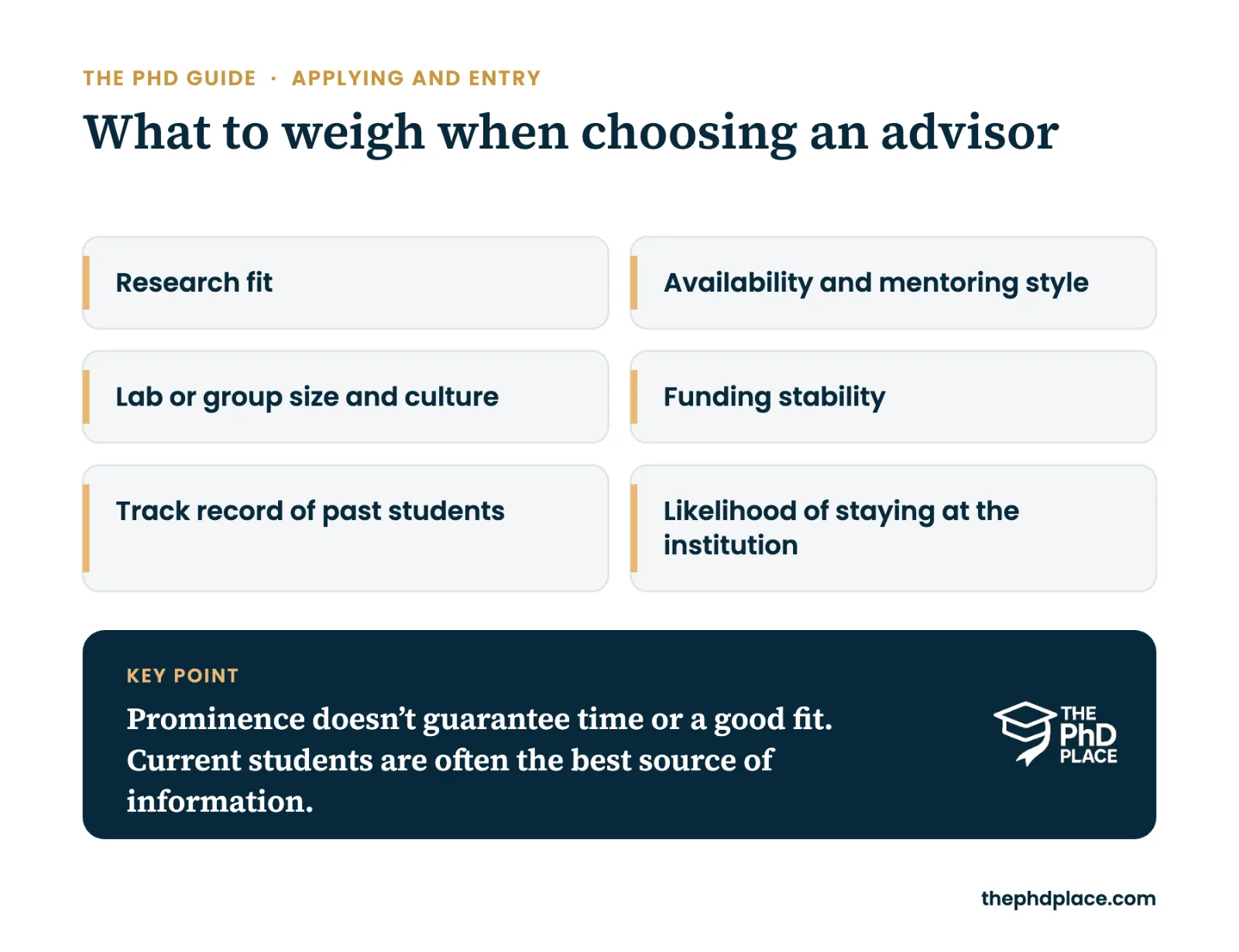
Beyond research fit, students frequently weigh an advisor’s availability and mentoring style, the size and culture of the lab or group, funding stability, the track record of past students, and whether the advisor is likely to remain at the institution. Many programs also require a dissertation committee of several faculty members, which can broaden support beyond a single advisor.
International comparison
In the UK and much of Europe, applicants typically secure a supervisor before admission and apply to work on a specific project from the outset. Supervisory teams of two or more academics are also common there.
Common misunderstandings
It is often assumed that the most famous faculty member will be the best advisor. Prominence does not guarantee time, accessibility, or a good working fit, and current students are often the best source of information about this.
Another misunderstanding is that an advisor directs every aspect of the research. Doctoral study is designed to develop independence, and the balance of guidance and autonomy usually shifts over time. Changing advisors is also possible and not uncommon, as discussed in What happens if things go wrong during your PhD.